Domus de Janas: Why Sardinia's Ancient Tombs Became UNESCO Site
Domus de Janas: Sardinia's ancient tombs joined UNESCO's World Heritage list in 2025. Discover their uniqueness, the Mother Goddess cult, and local travel tips.
8/23/20253 min read
Why they matter
But remember: these are only the UNESCO-listed ones. Archaeologists estimate there are over 3,500 Domus de Janas spread throughout Sardinia, making them one of the most extensive prehistoric archaeological sites in the Mediterranean.
The UNESCO recognition of the Domus de Janas is not just a certificate, it is an invitation to discover Sardinia beyond its beaches.
It is an opportunity to walk into the island's prehistoric heart, where life, death, and spirituality were carved in stone.
Exploring them means reconnecting with an ancient past that still resonates today, realizing that Sardinia is not only a land of sea and sun, but also a place where history and myth live side by side, waiting to be rediscovered.
Ready to explore Sardinia’s prehistoric treasures? Start planning your tailor-made journey with local insights, Plan Your Trip.
Sardinia is a Cultural Ecosystem
Sardinia is a cultural ecosystem where history, landscape, and food are all part of the same story.
Your discovery of Sardinia doesn’t end with its monuments. To truly understand the island, you must connect the past to the present. The land that held the Mother Goddess cult is the same land that now nurtures the most authentic traditions.
For exploring this continuity through taste, local know-how, and travel insights, visit our dedicated Food & Craft Journeys in Sardinia section.
Practical information for visitors
Best time to visit: spring (April - June) and autumn (September - October), when the weather is mild and sites are less crowded.
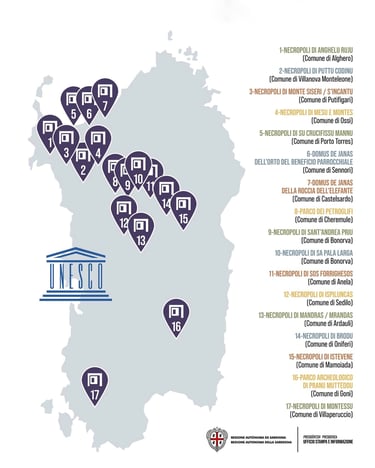
How to get there: The 17 UNESCO necropolises are concentrated mainly in the north and center of Sardinia, easily reachable from the airports of Alghero and Olbia, both connected by direct flights to major European cities. But Domus de Janas exist across the whole island, from the south to the heart of the interior.
What to expect: Some sites are part of organized archaeological parks with guided tours, while others remain hidden among landscapes where nature still dominates.
A new UNESCO recognition in Sardinia
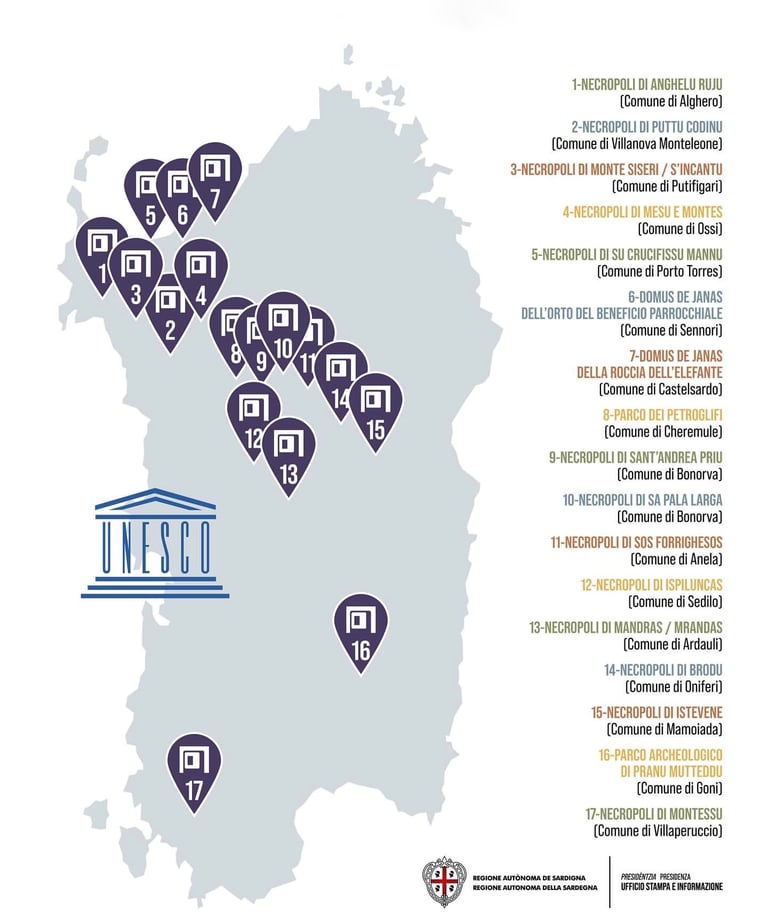
In July 2025, UNESCO officially recognized 17 necropolises of Domus de Janas ("fairy houses"), adding them to the World Heritage List.
These prehistoric rock-cut tombs date back to the Neolithic period (4th-3rd millennium BC), representing one of the island's most extraordinary legacies.
Spread across the island, the Domus de Janas are often decorated with carvings, symbols, and red ochre, offering a glimpse into the spiritual life of the ancient communities who built them.
Standing before these carved chambers means stepping into the silence of five thousand years ago. Inside, traces of red ochre, geometric motifs, and symbolic carvings still whisper of rituals and beliefs, revealing a worldview where life and death were deeply connected to the land.
What are the Domus de Janas?
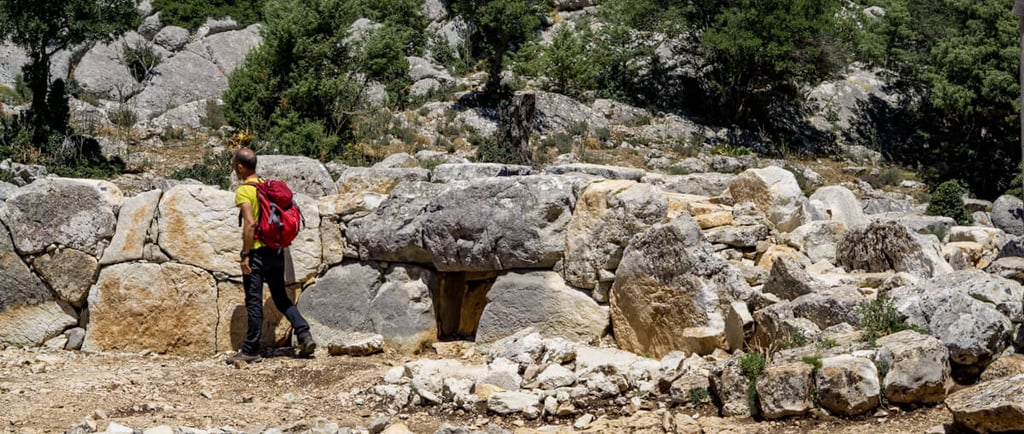
More than simple tombs, the Domus de Janas are true underground sanctuaries. Dug directly into the rock between the Neolithic and Eneolithic periods (approx. 4000–2000 BC), they reflect the profound bond between Sardinia’s earliest societies and the land itself.
Their uniqueness lies in their function: they were not merely burial places, but were carved to faithfully reproduce the houses of the living, featuring rooms, pillars, and even false doorways. These architectural details, along with ritualistic symbols and the use of red ochre for rebirth rituals, make them a phenomenon of their own.
Crucially, the Domus predate and are functionally distinct from the island’s later megalithic structures: they are much older than the Nuraghi (complex towers built during the Bronze Age for habitation and defense) and the Giants' Tombs (later Bronze Age gallery tombs used for collective burials). The Domus represent a prior ritual phase focused on the cult of the Mother Goddess. This belief celebrated fertility and the cycle of life-death-rebirth. Their very name, "Fairy Houses" in Sardinian folklore, underscores their mythical and mysterious role.
Walking through these narrow passages, you don’t just “visit” an archaeological site, you feel part of a timeless story that connects myth, ritual, and everyday life, revealing Sardinia as a true open-air museum of the Mediterranean.
The 17 newly recognized UNESCO sites
Here are the necropolises officially included in the World Heritage List:
Necropoli di Anghelu Ruju (Alghero, SS)
Necropoli di Puttu Codinu (Villanova Monteleone, SS)
Necropoli di Monte Siseri / S’Incantu (Putifigari, SS)
Necropoli di Mesu e Montes (Ossi, SS)
Necropoli di Su Crucifissu Mannu (Porto Torres, SS)
Domus de Janas dell’Orto del Beneficio Parrocchiale (Sennori, SS)
Domus de Janas della Roccia dell’Elefante (Castelsardo, SS)
Parco dei Petroglifi (Cheremule, SS)
Necropoli di Sant’Andrea Priu (Bonorva, SS)
Necropoli di Sa Pala Larga (Bonorva, SS)
Necropoli di Sos Furrighesos (Anela, SS)
Necropoli di Ispiluncas (Sedilo, OR)
Necropoli di Mandras/Mrandas (Ardauli, OR)
Necropoli di Brodu (Oniferi, NU)
Necropoli di Istevene (Mamoiada, NU)
Parco Archeologico di Pranu Mutteddu (Goni, CA)
Necropoli di Montessu (Villaperuccio, SU)


Privacy Policy
Cookie Policy
Terms & Conditions
FAQ
BLOG
CONTACT US
© 2025 Sardinia Like a Local. All rights reserved.
P.IVA: 03345460921